
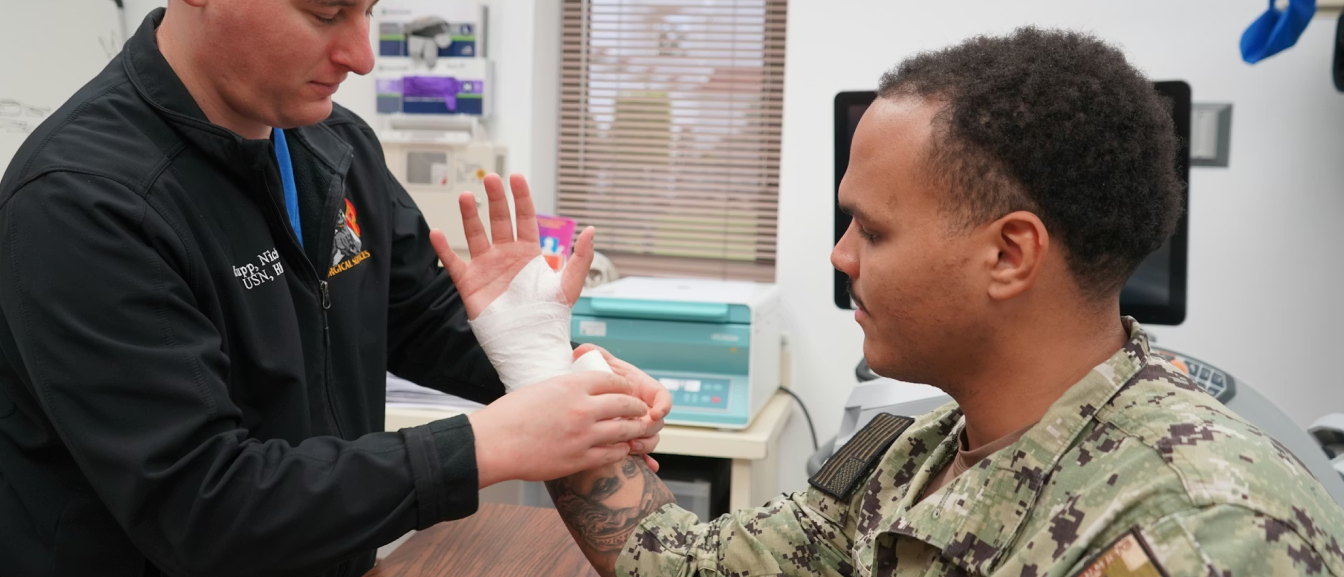
Ology is developing a technology platform that will significantly improve patient care for healthcare providers and the people they serve. But in the spirit of the why before the what, take a moment to consider Vernon Mills, a U.S. Veteran of the Gulf War’s Operation Desert Storm whose battle injuries have followed him for more than 35 years. We believe a new kind of technology — one that introduces very little new data into the ecosystem and instead amplifies the knowledge and understanding of the professionals already inside the healthcare system — can yield profound improvements for patients like Vernon, and for millions of other vets.
Service members deserve our best… and so do their care providers.
Full disclosure: Vernon Mills isn’t an actual soldier (or even a real person). Vernon represents every soldier who has served in the past 60+ years, sustained injuries, and continues to receive care even today. Vernon is a persona built from the experiences of the nearly half-million men and women shaped by the clinical realities of conditions like Gulf War Illness and so many other service-related maladies. He’s in his mid-sixties now, and the symptoms he lives with daily, like chronic fatigue, persistent aching, and cognitive challenges that come and go without warning, have plagued him for more than 30 years.
Vernon lives in a suburb of Washington, DC, and he knows his local VA Medical Center team well. They know him too. He is far too familiar with the routines and protocols, and he respects the staff. The physicians and nurses caring for him are capable, committed, and doing their best in a system that asks a great deal of them. Vernon knows they care about him. And yet, reaching full wellness — or even feeling significantly better — remains a bridge too far. It isn’t that Vernon is not receiving decent care; he is. It is that the care often feels episodic rather than connected. One appointment leads to another. One specialist hands off to the next. Each interaction is thoughtful on its own, but rarely does it produce a full picture of his chronic condition, his medical history, or the context of his health journey. His care simply is not being brought together in any coordinated way. This is not a story about what is broken; it is a story about what is being missed.
Inside the walls of every VA health facility, there is immense medical experience, dedication, expertise, and compassion. Some of those clinicians have served in the same theaters of war as Vernon. Others focus their entire research on the constellation of symptoms he lives with. They all know which providers are best suited to care for patients like Vernon — not because of his medical chart, but because they have observed similar cases time and time again. The lack of cohesion is not a healthcare problem; it is an alignment problem.
Performance gaps aren’t unique to the hospital environment. They show up in every organization that depends on skilled people operating in complex, often chaotic conditions where time is of the essence and precision is non-negotiable. Healthcare just happens to be among the most vital environments — with the highest stakes and the most to lose.
If only we knew what we know…
Much of Ology’s approach to problem-solving was inspired by a book written nearly three decades ago. The specific paradigms it discussed have been outpaced by today’s challenges, but its title rings as true as ever. Seven simple words: If Only We Knew What We Know. It captures something obvious and almost always overlooked: the knowledge an organization desperately needs is most often found right inside its own walls — undiscovered. The hard part isn’t acquiring that knowledge; it’s finding it, surfacing it, and activating it. Despite decades of investment in enterprise systems, knowledge management platforms, internal directories, search, chat, and every collaboration tool under the sun, most organizations still cannot answer the question the book’s title is begging them to ask: What do we know?
On one hand — as humans, as a workforce, as a society — we know more today than we ever have. On the other, we don’t even know our colleagues like we once did. But invest a little time and effort, and you might meet a new co-worker — say, a software engineer — and discover after a short conversation that she is also a jazz musician, once taught high school economics, and was a land attorney before falling in love with code and switching paths. Now, should you ever have a question about Thelonious Monk, the causes of inflation, or how to build a home next to an easement, you know who to go to. That is the transfer of internal knowledge and best practices — also the subtitle of the book.
But better still — what if we didn’t have to ask or seek out information at all? What if it was just waiting for us when we needed it most? Not the kind of information your favorite AI device hands you when you type in a question, but the kind that quietly assembles a team in the background to solve a hard problem the moment you encounter the need — knowing that the strengths of that particular team will create results far greater than the sum of their parts. A way to draw on the knowledge of each team member: their experience, their skill (and an accurate assessment of the depth of both), combined with their work style, availability, and even their location. That kind of coordination can only happen when we know what we know. And in some cases, it can prove a literal lifesaver.
Solutions are right in front of us, if we’d only ask.
The ideas from the book — and our practical application of its premise — have stayed with us. Over the years, we’ve recognized how often internal knowledge goes unnoticed and untapped. Universities, hospitals, government agencies, software companies, startups, nonprofits, military units — none are immune to overlooking the richness of their own resources, and few have a reliable way to activate the knowledge that already lives inside their walls. Wherever there are talented, busy people, there will be a knowledge gap unless it is intentionally sought out. In most cases, job titles describe only about 20% of a professional’s real capability. The other 80% is tacit — documented nowhere and sought by no one.
Research has put harder numbers to what we were observing. Roughly nine out of ten things an organization knows at any given moment live inside the heads of its people, not inside its systems of record. Decades of investment in knowledge-management technology have not moved the needle much at all. The deeper truth is that institutional knowledge isn’t really a repository problem — it’s an alignment problem.
Enter, Knowlogy.
Knowlogy is a people platform. Its strength is in knowledge activation and alignment. It has been conceived and designed to do something organizations have struggled to pull off for years: harnessing the knowledge inside their walls and making it proactively visible, accessible, and actionable in real time.
Knowlogy is not intended to boil the ocean, nor is it striving to be “everything to everybody.” It is being developed to do three things very well:
01 — Capability profiles.
Knowlogy builds a dynamic capability profile of every person in the organization — not a résumé, but a true portrait of who they are as a professional. It captures what each individual is trained to do, where they have served, what they have seen, who they have cared for, what they have taught, along with their ratings, certifications, evaluations, and feedback from colleagues and patients alike. The result is a complete, real-time picture, validated and updated continuously as new outcomes, experiences, and feedback come in. This is a stark shift from the standard reliance on a résumé, bio, or diploma — documents that typically only get updated when a new credential is earned.
02 — Real-time presence.
Knowlogy maintains real-time awareness of presence through Whosin, a location and proximity stack that uses mobile devices, beacons, and other signals to know where medical staff are physically situated during their shifts. This allows Knowlogy to align a patient with the right clinician for the situation — matched on capability, available at the right time, and within the right proximity for critical concerns that require in-person care. This is especially valuable in critical care situations when moments of crisis demand the timeliest of responses.
03 — Alignment engine.
Most importantly, Knowlogy’s alignment engine integrates everything the system knows (capability profiles, history, expertise) with everything it senses in the moment (patient status, criticality of the situation, availability and locality of resources via Whosin) and assembles the right team for each specific situation. Not a single match, but a configuration of people who, together, represent the strongest combination of capability for the patient, the incident, and the need. The engine doesn’t replace human judgment; it informs it in real time. The care coordinator, the department head, the charge nurse, and the physician still decide — but in a fraction of the time, and with greater precision than ever before.
What the future holds.
Before Vernon arrives at the VA medical center, the work has already begun. Knowlogy has reviewed his record against the capability profiles of every clinician across the entire health system — not just the building he is walking into. From that network, it has surfaced the small group whose experience most closely aligns with his condition: a specialist in the cognitive effects of Gulf War Illness, a pain physician with a history of treating veterans with comparable profiles, and a doctor who served in the same theater decades earlier.
Proximity matters differently depending on the circumstance. In an emergency, the system identifies who is in the building, who is available, and who can put hands on the patient fastest. In a non-emergency encounter like Vernon’s, proximity becomes more flexible. The lead clinician sitting with Vernon may be on-site, but the specialist whose expertise is most relevant could be three states away. Knowlogy can cue a live virtual connection — a WebEx session, for example — bringing that specialist into the exam room in real time, without scheduling, without referral delays, without Vernon being asked to come back another day.
The team does not need to physically convene. What is needed is a shared understanding of the patient before the first conversation begins. Knowlogy generates a concise briefing for the lead clinician — Vernon’s history, the relevant clinical context, and the reasoning behind each team member’s inclusion — so the physician walks into the room already informed by the collective knowledge of the team. The result is a different kind of encounter. Fewer questions. More answers. Less time spent retracing ground Vernon has covered many times before, and more time spent on what comes next.
This is where healthcare must go. Not toward more technology between the clinician and the patient, but toward an underlying and largely invisible system that orchestrates everything the doctor and the patient need — quietly, in the background — so that when the clinician sits down with the patient, the full capability of the network is already in the room.
More than a healthcare story.
Yes, this is a patient care story. But it is so much more. The pattern Knowlogy addresses shows up wherever organizations depend on highly skilled people performing in fast-paced, overburdened, chaotic, and highly consequential environments. Cyber defense, aviation and transit, military operations, broadcast news, and so many other industries could benefit greatly from “knowing what they know.”
When organizations have full comprehension and command of their institutional knowledge and best practices, they become equipped to act with precision, respond with speed, and deliver outcomes that were previously out of reach. Operations become safer, because the best person for the situation is engaged every time — not the closest available substitute. Outcomes become more predictable, because decisions are informed by the full weight of an organization’s experience and knowledge. Costs come down, not through reduction, but through efficiency. Time, talent, and attention are spent where they will have the greatest impact.
The deeper benefit is human. When people are surrounded by the full intelligence of their institution, they perform at the level every moment demands.
Knowlogy is being built for any environment where skilled people are critical to achieving their organization’s mission — under pressure, with limited time and resources, and where outcomes matter most. Healthcare is the first domain we are going deep on, because the stakes are high and the need is urgent — but the platform will expand until everyone knows what they know.
An extensive white paper exploring the platform’s mechanics and the broader research implications of this work is being published, covering alternate applications in cyber defense, national and global news media, and other mission-critical environments.